
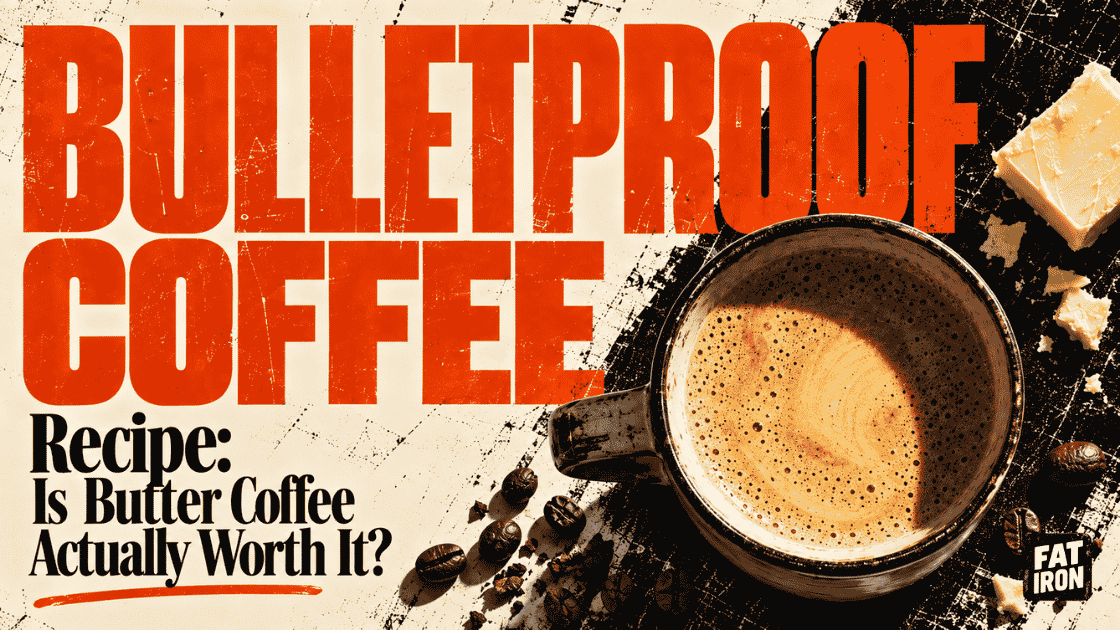
Bulletproof coffee is one of those recipes that sounds ridiculous until you actually try it.
Hot coffee goes into a blender with butter or ghee and MCT oil. Thirty seconds later, what was ordinary black coffee becomes thick, frothy, creamy, and surprisingly close to something you would expect from a coffee shop.
That part is real.
Where bulletproof coffee gets more complicated is everything people have attached to it: better focus, endless energy, appetite suppression, weight loss, ketosis, productivity, and the idea that it can replace breakfast entirely.
That is where Fat Iron takes a slightly different approach.
Coffee can absolutely be part of a good morning. Fat can make coffee more satisfying. MCT oil has some interesting properties. And for certain people, drinking something may genuinely be easier than forcing down a full breakfast first thing in the morning.
But adding two types of fat to coffee doesn’t automatically make it nutritionally complete.
So instead of treating bulletproof coffee as a miracle drink, let’s make a good version of it, understand what is actually happening, and figure out when it might—or might not—make sense.
What Is Bulletproof Coffee?
Bulletproof coffee, sometimes called butter coffee or keto coffee, is traditionally made by blending hot coffee with butter or ghee and MCT oil.
Blending matters.
If you simply drop butter into coffee and stir it, you’ll probably end up looking at an oily slick floating on top of your mug.
A blender emulsifies the fat into the coffee, producing the creamy texture that makes the drink surprisingly enjoyable.
The basic formula is simple:
- Hot brewed coffee
- Butter or ghee
- MCT oil
- Optional salt, cinnamon, vanilla, or other flavorings
The Cookie Rookie version that inspired this article uses 12 ounces of coffee, 2 tablespoons of ghee, and 1 tablespoon of MCT oil. That produces a drink containing roughly 388 calories and 43 grams of fat—but just 1 gram of protein.
That nutritional breakdown is important.
It tells us exactly what bulletproof coffee is good at providing.
Energy from fat.
It also tells us what it isn’t providing very much of.
Protein, fiber, carbohydrates, vitamins, minerals, and most of the things you’d normally expect from an actual meal.
Fat Iron Bulletproof Coffee Recipe
You don’t need specialty coffee beans or an expensive branded butter coffee system.
Good coffee is enough.
Ingredients
- 10-12 ounces freshly brewed coffee
- 1 teaspoon to 1 tablespoon MCT oil
- 1 tablespoon unsalted butter or ghee
- Pinch of salt
- 1/4 teaspoon cinnamon, optional
- Splash of vanilla extract, optional
Instructions
Add the hot coffee, butter or ghee, MCT oil, salt, and any optional flavorings to a blender.
Blend for approximately 20-30 seconds, until the coffee becomes creamy and frothy.
Pour it into your mug and drink immediately.
That’s it.
The most important difference in my version is the starting quantity of MCT oil.
You don’t need to dump a tablespoon of it into your first cup.
If you’ve never used MCT oil before, start small.
Very small.
A teaspoon is plenty.
You can always increase it later.
Your digestive system will make the final decision.
Why Put Butter in Coffee?
The appeal isn’t as strange as it initially sounds.
Fat carries flavor extremely well.
It’s part of why cream changes coffee so dramatically and why adding butter can soften bitterness while creating a fuller mouthfeel.
When emulsified properly, butter coffee becomes almost latte-like without using milk.
Fat is also extremely energy dense.
One gram of fat contains approximately nine calories, compared with about four calories per gram for protein or carbohydrate.
That means a relatively small amount of butter and oil can add hundreds of calories to coffee very quickly.
For someone who struggles to eat enough early in the day, that may occasionally be useful.
For someone trying to reduce total calorie intake, the exact same property could work against them.
Context matters more than the ingredient.
What Is MCT Oil?
MCT stands for medium-chain triglycerides.
They’re fats composed primarily of medium-chain fatty acids, which are handled somewhat differently by the body than many longer-chain dietary fats. Research has therefore looked at MCTs for applications involving energy metabolism and clinical nutrition.
That’s the interesting part.
The internet then did what the internet does and turned an interesting nutritional characteristic into claims that MCT oil would make everyone leaner, sharper, faster, and essentially invincible before 9 a.m.
Reality is less dramatic.
MCT oil is still dietary fat.
It provides calories.
It can be useful in some circumstances.
It is not magic.
The Gut Part of Bulletproof Coffee Matters
This is where the Fat Iron lens becomes especially important.
You’re combining two things capable of getting your digestive system’s attention:
coffee and concentrated fat.
Coffee itself can stimulate colonic activity in some people, and research suggests that some gastrointestinal effects aren’t explained by caffeine alone.
A broader 2024 review also found that coffee interacts with several aspects of bowel function and potentially the gut microbiome, although researchers continue to find conflicting results depending on the outcome being studied.
That means there isn’t one universal response to coffee.
Some people drink it and feel great.
Some immediately need to find a bathroom.
Some tolerate one cup but not three.
Some tolerate coffee after food considerably better than coffee on an empty stomach.
Then you’re adding MCT oil.
This is why starting with a teaspoon instead of immediately using a full tablespoon makes sense.
Food tolerance isn’t a toughness competition.
If one teaspoon works beautifully and one tablespoon makes your stomach revolt, one teaspoon is the better recipe.
The Brain Part: Why Bulletproof Coffee Can Feel So Good
Coffee is already a potent ritual.
Smell the beans.
Grind them.
Hear the machine.
Pour the coffee.
Take the first hot sip.
Then caffeine starts doing what caffeine does.
Adding butter and MCT oil makes that sensory experience even stronger because the drink becomes richer, smoother, and more substantial.
For someone who has difficulty getting interested in breakfast, that can matter.
Sometimes nutrition advice assumes appetite behaves like a spreadsheet.
“You need 30 grams of protein, so eat 30 grams of protein.”
Great.
Except humans aren’t spreadsheets.
Appetite, sensory preference, stress, sleep, medication, routine, time pressure, and digestive tolerance can all influence whether someone actually wants to eat.
A food or drink you will reliably consume can sometimes become the bridge to a better morning routine.
That’s where I think bulletproof coffee gets genuinely interesting.
Not as breakfast.
As a tool.
But Is Bulletproof Coffee Good for Focus?
This is where separating coffee from everything added to coffee becomes difficult.
If someone drinks butter coffee and suddenly feels more alert, the obvious question is:
Was it the butter?
The MCT oil?
Or the caffeine?
Probably don’t ignore the ingredient with one of the most recognizable stimulant effects on Earth.
People can certainly prefer the subjective experience of caffeine alongside calories or fat versus drinking plain coffee on an empty stomach.
But that is different from saying butter itself is a cognitive enhancer.
If bulletproof coffee helps your morning feel smoother, that’s useful information.
You don’t need to turn the experience into a biochemical miracle for it to have value.
Is Bulletproof Coffee a Good Breakfast?
Usually, I wouldn’t treat traditional bulletproof coffee as a complete breakfast.
That’s probably the biggest distinction I’d make between Fat Iron and many keto-era versions of this recipe.
Traditional butter coffee can contain several hundred calories while providing almost no protein or fiber.
The Cookie Rookie recipe, for example, lists approximately 388 calories with 43 grams of fat and just 1 gram of protein.
Cleveland Clinic has similarly cautioned that traditional butter coffee can be very high in calories and saturated fat while offering relatively few nutrients compared with eating a more complete meal.
That doesn’t make it “bad.”
It makes it incomplete.
Those are very different things.
The Fat Iron Upgrade: Add Protein Somewhere
If I were building a morning around bulletproof coffee, protein is the first thing I’d think about.
You could pair it with:
Eggs.
Greek yogurt.
Cottage cheese.
A protein shake.
Leftover steak or chicken.
A breakfast sandwich.
Whatever works.
You don’t necessarily need to cram everything into the coffee.
Actually eating alongside your coffee is perfectly legal.
For someone training regularly, this makes the morning considerably more useful because you’re no longer relying on several hundred calories of fat as your primary nutrition.
You’re turning enjoyable coffee into part of a meal.
Can You Put Protein Powder in Bulletproof Coffee?
Yes, although technique matters.
Very hot liquids can make some protein powders clump or create a texture you probably weren’t imagining when you started.
One option is to blend the protein directly into the finished coffee.
Another is to let the coffee cool slightly before adding the powder.
Collagen blends extremely easily into coffee, but collagen isn’t nutritionally equivalent to a complete protein source such as whey, casein, soy, egg, or a well-formulated plant protein.
If your goal is simply adding collagen, great.
If your goal is supporting muscle protein synthesis and increasing total daily protein intake, use an appropriate complete protein source or eat one alongside the drink.
Does Bulletproof Coffee Help With Weight Loss?
This question deserves more skepticism than most bulletproof coffee recipes give it.
Adding calories doesn’t automatically produce weight loss just because those calories come from fat.
A high-fat drink may help some people feel satisfied enough to eat less later.
For someone else, it may simply add 300-400 calories to the same breakfast they were already going to eat.
Both outcomes are possible.
That’s why asking whether a food is “good for weight loss” isn’t usually the most helpful question.
A better question is:
What does this food cause me to do during the rest of the day?
If a smaller bulletproof coffee makes your morning easier, controls hunger, and helps you eat intentionally later, that’s useful.
If it disappears into your stomach like flavored water and you’re hungry 45 minutes later anyway, you’ve learned something equally useful.
Your response matters.
What About Intermittent Fasting?
Traditional bulletproof coffee contains calories.
Quite a few of them.
So if by fasting you mean consuming essentially no calories, butter coffee ends the fast.
Some approaches to ketogenic dieting or intermittent fasting use different definitions and may still incorporate fat-containing coffee.
That’s a dietary strategy rather than a universal rule.
Again, figure out what you’re actually trying to accomplish before letting terminology dictate breakfast.
Bulletproof Coffee Before Training
This is another place where context matters.
Coffee before training?
Very common.
Several hundred calories of butter and MCT oil immediately before hard training?
That deserves an experiment before race day, squat day, or the workout where your coach has decided burpees are apparently a personality test.
Fat digests relatively slowly compared with easily digested carbohydrates, and large amounts may feel heavy during intense exercise.
Meanwhile, coffee itself can stimulate bowel activity in some people.
You can probably see where this is going.
Test your tolerance.
A small coffee with a little fat may feel great.
A giant butter coffee before running intervals may become a valuable lesson in restroom geography.
A Better Pre-Workout Version
If I wanted bulletproof-style coffee before training, I’d keep it lighter:
- 8-10 ounces coffee
- 1 teaspoon MCT oil
- 1 teaspoon butter or ghee
- Pinch of salt
- Cinnamon
Then I’d get actual training fuel elsewhere depending on the session.
For a strength session, that might mean some protein and carbohydrates.
For an easy morning session, perhaps nothing else is necessary.
For long endurance work, you’re eventually going to need a substantially better fueling strategy than hoping butter coffee carries you through several hours.
Can You Make Bulletproof Coffee Without MCT Oil?
Absolutely.
Use coffee and butter or ghee.
You can also use coconut oil, although coconut oil and purified MCT oil aren’t exactly the same thing.
Or skip the additional oil entirely.
The blender is doing much of the culinary magic here.
Coffee plus a small amount of butter can still create a rich, creamy drink.
Can You Make It Without Butter?
Yes.
If dairy isn’t your thing, you can experiment with coconut oil, coconut cream, or another fat source that emulsifies well.
Just remember that changing the ingredients changes both the flavor and nutritional profile.
This is cooking.
You’re allowed to adjust things.
Why Salt Makes Butter Coffee Better
This isn’t a health hack.
It’s just good cooking.
A tiny pinch of salt can soften bitterness and bring out other flavors in coffee.
The key word is tiny.
You don’t want salty coffee.
You want enough salt that you don’t consciously notice it but wonder why the coffee tastes rounder and more balanced.
That’s one of those little kitchen techniques that matters far more than buying a bottle covered in performance claims.
Try Cinnamon Too
Cinnamon and coffee naturally work together.
It provides warmth and perceived sweetness without requiring much additional sugar.
I like about 1/4 teaspoon blended into the drink.
Vanilla works well too.
If you want something closer to dessert, a little cocoa powder can take the recipe in another direction entirely.
That’s where bulletproof coffee becomes more interesting to me.
Stop thinking of it as a supplement delivery mechanism.
Start treating it like food.
Make it taste good.
Fat Iron’s Bulletproof Coffee Rule
Here’s the simple version.
Use bulletproof coffee when it solves a problem.
Maybe you have very little appetite first thing in the morning.
Maybe you want something richer than black coffee.
Maybe a small amount of fat makes your morning coffee feel considerably more satisfying.
Maybe you’re trying to increase calorie intake.
Maybe you just think butter coffee tastes incredible.
All legitimate reasons.
But don’t automatically replace breakfast with 400 calories of butter and oil because somebody on the internet said it “optimizes” you.
Protein still matters.
Fiber still matters.
Micronutrients still matter.
Your total diet still matters.
And your gut gets a vote.
That’s the entire Fat Iron approach in a cup.
Not perfect eating.
Not diet tribes.
Not turning breakfast into another performance test.
Just figuring out what helps your brain work, what your gut tolerates, what supports the body you’re asking to train, and then cooking—or blending—something you actually enjoy.
Frequently Asked Questions
What is bulletproof coffee made of?
Traditional bulletproof coffee combines brewed coffee, butter or ghee, and MCT oil. The ingredients are blended together to emulsify the fats and create a creamy texture.
How do you make bulletproof coffee?
Add hot coffee, butter or ghee, and MCT oil to a blender and blend for approximately 20-30 seconds until smooth and frothy.
What is the difference between bulletproof coffee and butter coffee?
The terms are frequently used interchangeably. Some people use “bulletproof coffee” specifically for versions containing both butter and MCT oil, while butter coffee can refer more broadly to coffee blended with butter.
Can I use regular coffee?
Yes. You don’t need specialty beans to make butter coffee.
How much MCT oil should I put in bulletproof coffee?
If you’re unfamiliar with MCT oil, start with around 1 teaspoon rather than immediately using a large serving. Increase it only if you enjoy it and tolerate it well.
Is bulletproof coffee keto?
A traditional recipe contains very little carbohydrate and is commonly used within ketogenic diets.
Is bulletproof coffee breakfast?
It contains substantial calories, but traditional versions are primarily fat and coffee. Pairing it with protein and more nutrient-dense food generally makes it a more complete meal.
Can bulletproof coffee upset your stomach?
It can. Coffee affects gastrointestinal function in some people, and a sudden large amount of added fat may not agree with everyone. Start small and use your own tolerance as the guide.
Excerpt: This bulletproof coffee recipe turns coffee, butter, and MCT oil into a rich, creamy drink—but is butter coffee actually a good breakfast? Here’s how to make it, how to make it easier on your gut, and how to build a more useful morning around it.
Suggested URL: /bulletproof-coffee-recipe/
Primary keyword: bulletproof coffee recipe
Secondary keywords: butter coffee recipe, how to make bulletproof coffee, bullet coffee recipe, bulletproof coffee ingredients, how to make butter coffee, bulletproof coffee MCT oil